
A Stone Path for the Muddy Shortcut Across Your Yard
Every yard has a route people and dogs take no matter where the sidewalk is, and in wet winter weather it turns to mud. A stone path along that line keeps feet and floors cleaner.
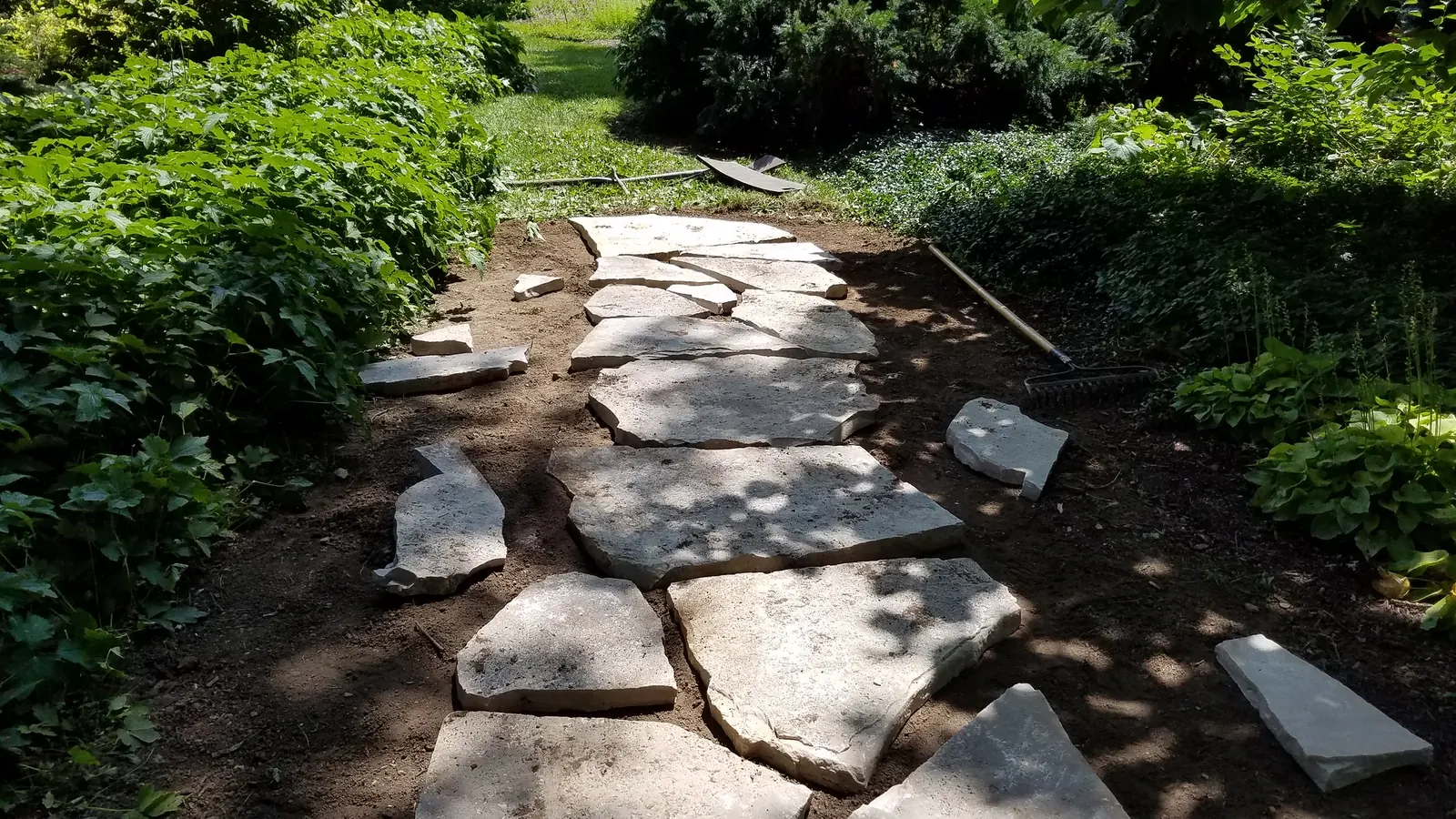
Most yards have a path that nobody planned. It runs from the back door to the gate, from the driveway to the side yard where the trash cans live, or along the fence where the dog patrols. Grass gives up along that line, and once the cooler, wetter months arrive it turns into a strip of mud that ends up on shoes, paws, and floors.
Before laying any stone, accept the route people actually use. A curving path that looks nice on paper will be ignored if it adds steps to the trip. Walk the worn line yourself, note where it starts and ends, and use that as the layout. Mark it with spray paint or a garden hose and look at it from the house for a few days before committing.
Stepping stones and a continuous walkway suit different jobs. Stepping stones set in lawn or gravel are simple, let rain soak in between them, and work well for light everyday traffic. A continuous flagstone walk, with tight joints filled with gravel or set on a mortar base, is better where wheelbarrows and trash cans roll or where traffic is heavy, and it is easier to sweep. Stone choice matters too. Flagstone with a natural textured surface gives better footing when wet than very smooth stone.
For stepping stones, spacing is what makes the path comfortable. Set them to match a normal stride, and test the layout by walking it before anything is dug in. Each stone should sit close to flush with the ground around it so a mower can pass over and nobody catches a toe.
The base decides whether the path stays put. Cedar Park soils range from thin and rocky to heavy clay, and both can shift. Dig out the soil under each stone or along the whole walkway, add a compacted layer of crushed gravel, then set the stone on a leveling layer and tap it down until it no longer rocks. A stone that wobbles will keep sinking on one side and become a tripping hazard.
Water is the reason the shortcut turned to mud in the first place, so look at drainage before you build. If the worn line sits in a low spot where water collects after rain, a path alone will just sit in a puddle. Raising the grade, adding gravel along the edges, or giving the water another way out may need to come first. Downspouts that empty right onto the route are another common cause.
Finish the edges so the path looks intentional. A border of gravel, a low ground cover between the stones, or a planting bed along one side helps the path blend into the rest of the landscape. Where the path meets a patio or a gate, match the heights so there is no lip to trip on.
Lopez Landscaping & Tree builds stone work, walkways, and patios for homes in Cedar Park and surrounding communities. If a muddy track across the yard has become part of your winter routine, ask for a free estimate and we will plan a path that follows the way your household actually moves.
Tired of tracking mud through the house?
We build stone paths, walkways, and patios for Cedar Park yards. Free estimates.